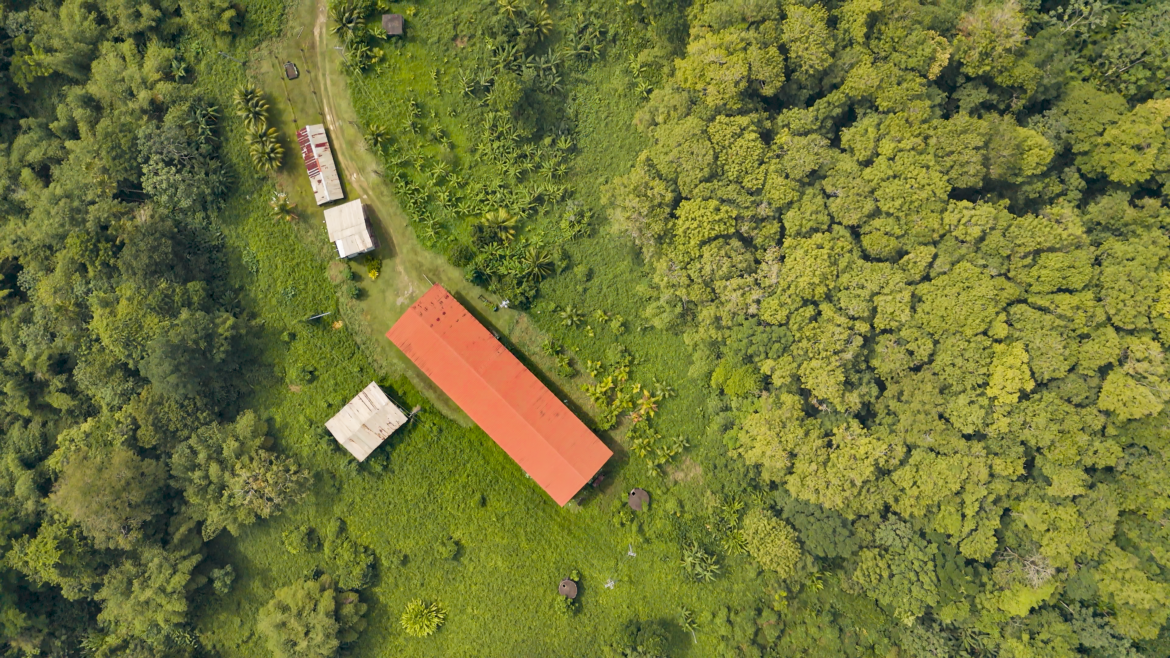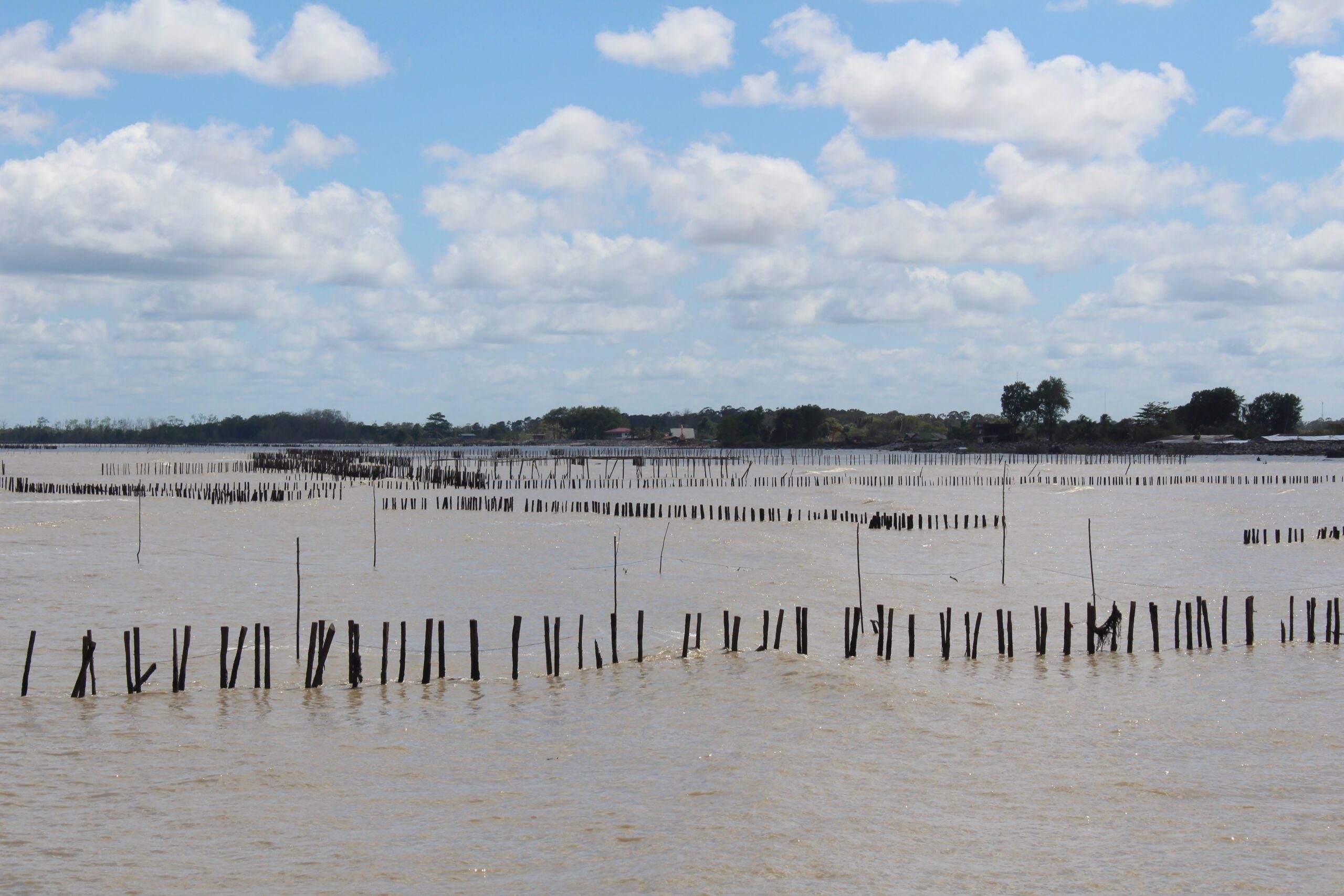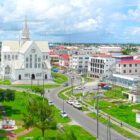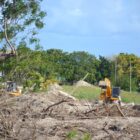
Remnants of Sediment Trapping Units (STUs) at Weg naar Zee, showing how earlier nature-based efforts to capture mud and rebuild the coastline have deteriorated over time

Battling the Waves at Weg Naar Zee

At the northwestern edge of Suriname’s capital, Paramaribo, the Atlantic Ocean relentlessly batters the shoreline. Here lies Weg naar Zee – literally “Road to the Sea” – long regarded as one of the country’s most vulnerable coastal zones. According to demographic data from the Central Bureau for Civil Affairs, the area had 14,047 registered residents with Surinamese nationality in 2024, placing thousands of people directly in the path of advancing tides. Standing in the heart of this fragile territory, it becomes clear that the question is no longer whether the sea will advance, but at what rate. The backyard of farmer Soerinderpersad Ganpat once dipped and swelled like an improvised battlefield, crossed by a clay ridge meant to hold back the sea.


The High Price of a Scarlet Macaw

The Scarlet Macaw that thrives in the dense forests of Belize are among the most prized birds in the world. Their impossibly bright plumage of fiery reds, orange, blues and green give a visual hint of their raucous personalities. They thrive on interaction with humans and live for 75 years or more in captivity. All those traits explain why pet owners sometimes pay as much as 15-thousand U.S. dollars to own one. It is also why poachers invade their nesting grounds every year and threaten their survival.


Two Weeks Later, Relentless Resilience Amidst Hurricane Melissa’s Aftermath

As the sun rises each morning over the battered coasts and battered communities, the scars left by Hurricane Melissa are everywhere. For miles all that can be seen are toppled power lines, damaged homes, and families struggling to regain a sense of normalcy. Yet, across the most-affected regions, a story of remarkable resilience and determination is unfolding. Hurricane Melissa struck Jamaica on October 28, 2025, as a Category 5 storm and it left a trail of destruction across vast stretches of the island, plunging entire communities into darkness and disrupting lives overnight. Torrential rains and hurricane-force winds devastated critical infrastructure and forced emergency officials into round-the-clock action.


Tricked into Sex Slavery: Global Crackdown hasn’t Stopped Caribbean Traffickers

Talia was struggling to make ends meet as a bartender in Santiago, Cuba, when a friend told her about a lucrative job opportunity in Suriname. The 26-year-old mother — who asked to be identified by a pseudonym to protect her privacy — had never heard of the Dutch-speaking country nearly 2,000 miles away. But the promise of a job that would help her provide for her family was too much to ignore. Santiago is Cuba’s second largest city and the home of Bacardi rum, but Talia said it offered few prospects for her: Wages there are low, and many people live without consistent running water or electricity. Talia was living in Santiago, Cuba (above), when she was offered a lucrative job in Suriname.


Mounting Challenges to Caribbean Fisheries

There are mixed official and industry messages in a selection of Caribbean countries, but CIJN investigations have unearthed, at minimum, signs that the regional fisheries sector is currently confronting a variety of potentially disastrous challenges – both natural and human. Over recent months, our team – comprising correspondents in Antigua and Barbuda, Barbados, Belize, St Vincent and the Grenadines, and Trinidad and Tobago – has scanned the regional seascape in search of data-supported evidence of a growing claim of perilous times ahead for the industry. In most instances, there has been a notable absence of available indigenous, official, statistics and an apparent unwillingness by authorities to publicly engage negative speculation regarding the fate of the fisheries sector. There have also been mixed verdicts from key stakeholders including fisherfolk and others involved in the value chain.


Guyana’s US$1.7B Gas-to-Energy Project: A Pathway to Prosperity or Pandora’s Box? 

Like many small-to-medium scale agro processors, 63-year-old Sandra Craig is eager for a solution to Guyana’s unstable power supply. Since moving from a small “snackette” in Orange Walk, one of the bustling streets in Georgetown, Guyana’s capital, to having her own agro-processing facility in Norton Street, Craig said major expansion could have been on the horizon were it not for the challenges posed by the country’s unreliable grid. 


Barbados’ Forgotten Few

There is evidence that the ageing population of Barbados is being disproportionately affected by climate-related illnesses such as dengue fever, respiratory infections, asthma, and heat exhaustion. 

Informed, strategic interventions are however stymied by the fact that there has been little systematic employment of data and targeted research.

According to the experts interviewed for this investigation, an increase in adverse climate events is both worsening health conditions and affecting the delivery of care.


Dominica Confronts Food Challenges Post Maria

After the devastation Hurricane Maria left behind on Dominica and the ensuing food shortages, officials and residents pledged not only to restore the island’s agricultural system but also to make it more self-reliant. 

But since 2017 food imports have soared. The Eastern Caribbean Central Bank (ECCB) in its data report showed that over the last six years since the storm, Dominica has imported more food in each of those years. In 2017, the country imported US$40 million worth of food, since then the number has ballooned to US$56 million – with meat, cereals, fruits and vegetables accounting for a large percentage of the bill. https://youtu.be/Xz96xHNu39M
Erica Burnett Biscombe speaking on wanting to give up (Video by Laila Langford)

Hurricane Maria damaged or destroyed much of the agricultural infrastructure, including buildings, animal husbandry facilities, agricultural roads and croplands. In a preliminary report by the government of Dominica, the agriculture sector reported US$ 179.6M (EC$ 485M) in loss and damage, impacting all aspects of agricultural production from crops, infrastructure, equipment to croplands. 

“Livestock damage includes 45 percent of cattle, 65 percent pigs and over 90 percent chickens with an estimated value of EC$ 8.68M (US$3.21M),” the government reported.