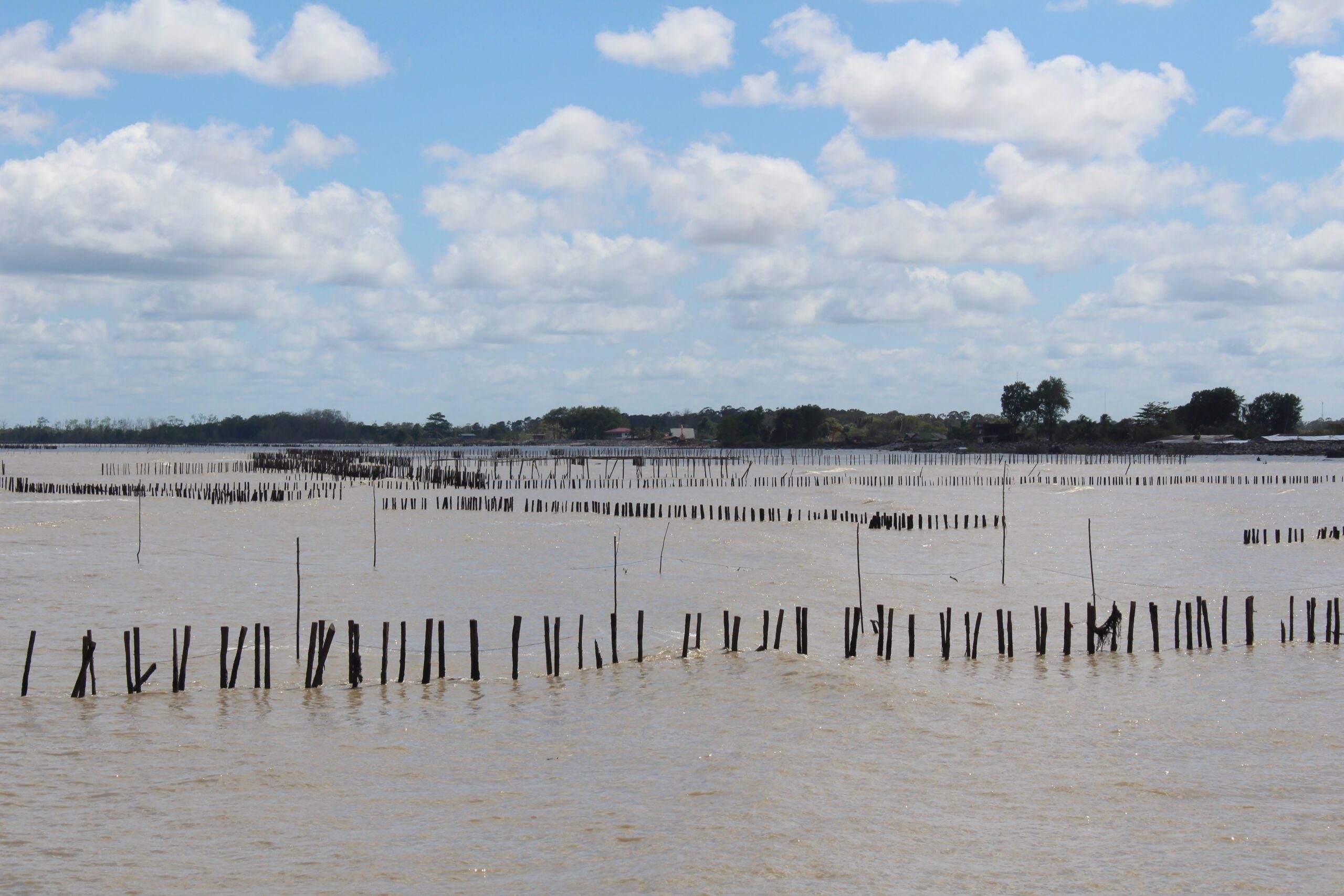
At the northwestern edge of Suriname’s capital, Paramaribo, the Atlantic Ocean relentlessly batters the shoreline. Here lies Weg naar Zee – literally “Road to the Sea” – long regarded as one of the country’s most vulnerable coastal zones.
According to demographic data from the Central Bureau for Civil Affairs, the area had 14,047 registered residents with Surinamese nationality in 2024, placing thousands of people directly in the path of advancing tides.
Standing in the heart of this fragile territory, it becomes clear that the question is no longer whether the sea will advance, but at what rate.
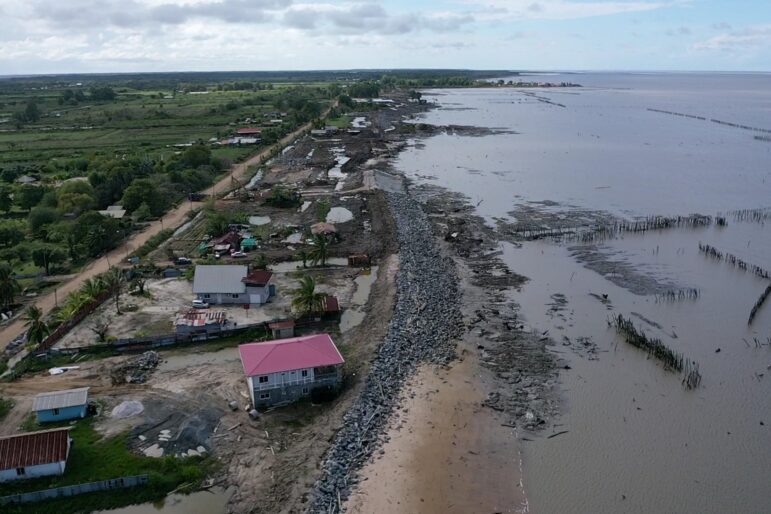
The backyard of farmer Soerinderpersad Ganpat once dipped and swelled like an improvised battlefield, crossed by a clay ridge meant to hold back the sea. The terrain has been leveled by the Ministry of Public Works, removing this informal defence.
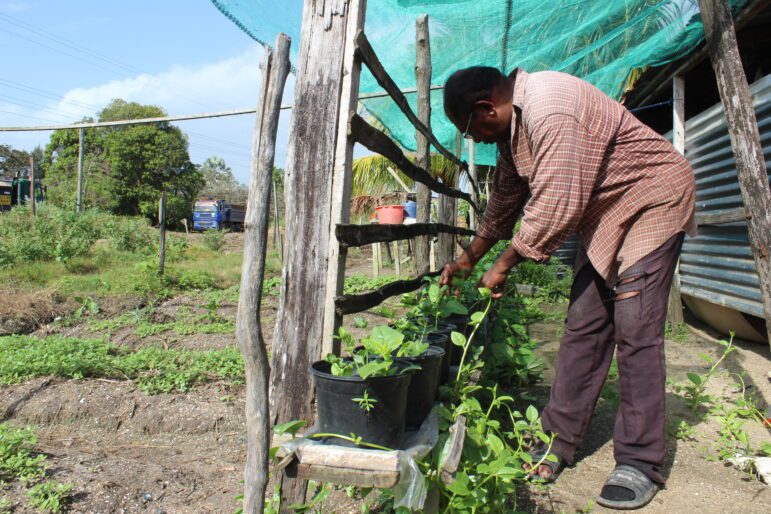
Behind his home sits the house of his 79-year-old father, surrounded by soggy, brackish earth. A little further stands the foundation of a new sea dike begun by the Ministry of Public Works, a long-awaited sign of hope in a landscape shaped by erosion.
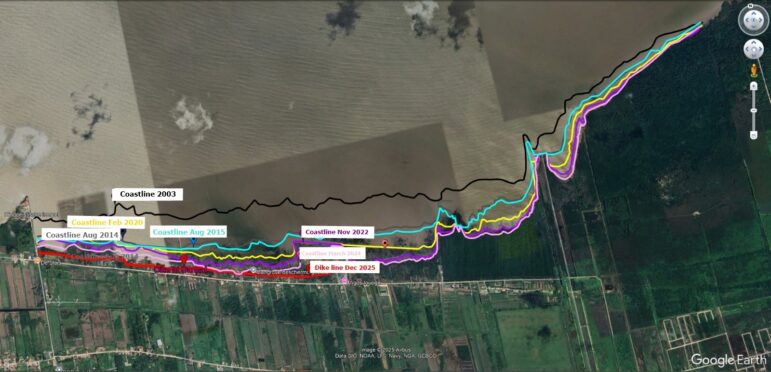
“When I bought this plot thirty years ago, it was about six hundred
metres long and a hundred metres wide,” Ganpat recalls, pointing beyond the eroded edge. “Behind those six hundred metres you still had almost a full kilometre of highland covered with vegetation, including mangroves. Now, about seventy metres remain.”
Ganpat farms vegetables, tends livestock, and sells his produce at a nearby market. His memories of the coastline form a timeline of disappearing land. “In 2009, the government built a clay dam that held for about six years until it broke in 2015”, he says.
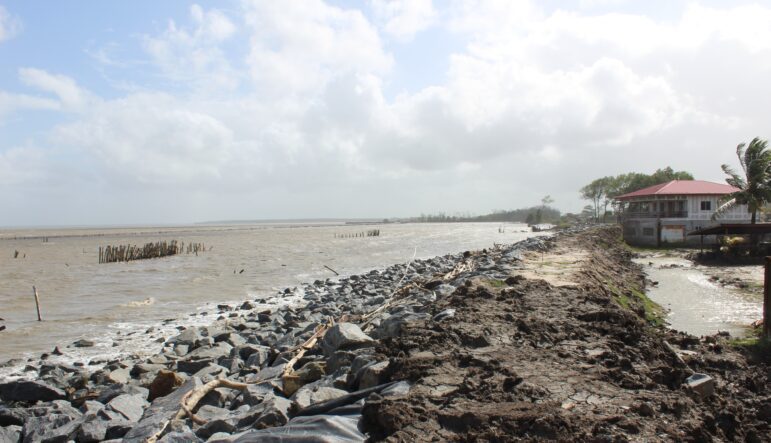
Subsequent dams eroded quickly, and floods became more frequent and forceful. Nature-based interventions brought temporary relief. Sediment Trapping Units (STUs) were installed to capture mud and create new land, and mangroves were planted atop the fresh sediment. For a while, it worked, until stronger tides and severe weather began overrunning the structures.
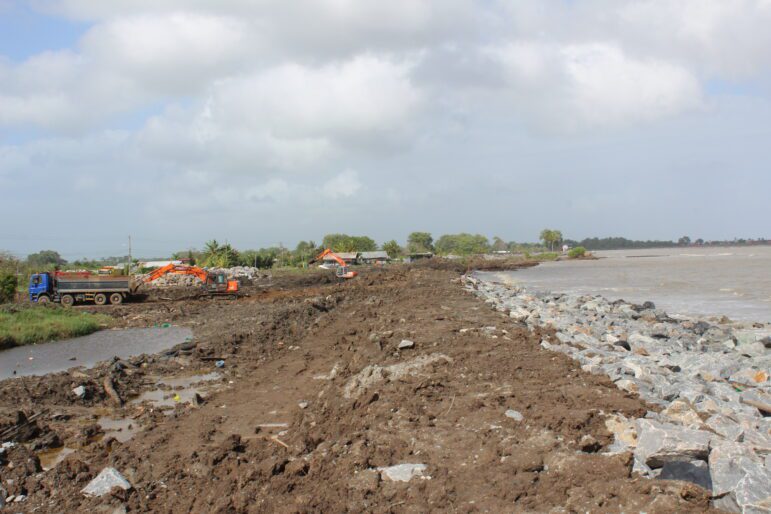
The turning point came in March 2025, when the government started to build a sea dike at a cost of 11.6 million US dollars. In October 2025, heavy flooding forced construction to halt for several days, underscoring the urgency of the crisis.
From his office in Paramaribo, Satish Mohan, Director of Civil Engineering Works at the Ministry of Public Works, explains how the project began.
Plans for a coastal dike at Weg naar Zee were first drafted in 2006, but financial constraints repeatedly stalled progress. Another complication was space. “For a dike, you need land,” he says. “But many people do not want to relocate. Some residents have lived there for 30, sometimes 40 years. Others depend on the area for farming and fishing.”
Eventually the government determined that a dike had become unavoidable. “This was an emergency measure,” Mohan says, “given how rapidly the situation was worsening.”
According to Mohan, the new dike is modeled after the one protecting the district of Nickerie, although at a smaller scale. “It consists of a clay body reinforced with rocks on the seaward side and is being constructed at a height of 3.5 metres NSP. It will span 4.5 kilometres, with completion estimated for July 2026.”
Mohan points to a potential enhancement, noting that a nature-based solution could be added on top of the existing hard infrastructure. “We might consider building a groyne in front of the dike, so we can stimulate land accretion,” a measure that could enhance long-term protection by encouraging sediment buildup.
The government is not the only actor at Weg naar Zee. For years, hydrologist and climatologist Professor Sieuwnath Naipal has worked on solutions rooted in nature. Since 2015, he has experimented with ways to slow erosion and rebuild the coast.
“When I started working in the area, erosion was already happening,” Naipal says. “I decided to begin with land accretion by capturing mud through an STU.”
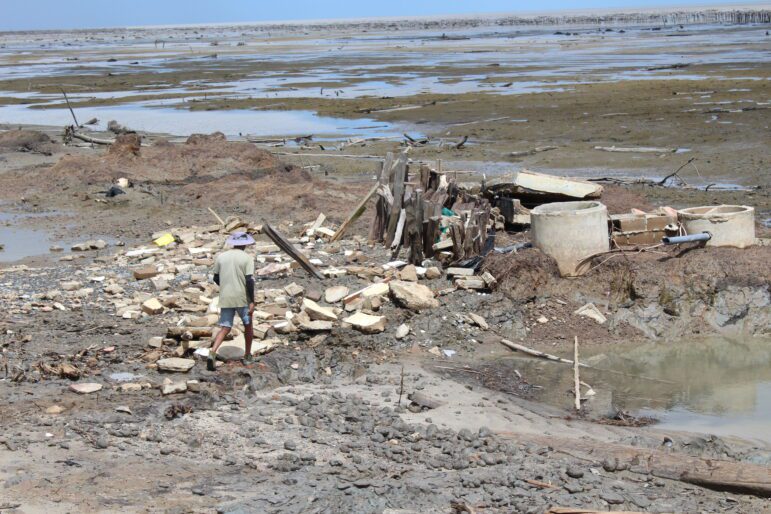
Once the mud settled, Naipal and volunteers planted mangroves as part of a rehabilitation project. Conservation International Suriname supported the construction of six additional STUs. But maintenance proved difficult. The triple-dip La Niña in 2020, 2021, and 2022 worsened conditions with higher tides and more turbulent sea levels.
Naipal believes other forces may also be at play. Dredging activities in the Suriname river since 2021 may have disrupted the natural movement of mudbanks that typically travel westward. If true, this could mean that sediment which once nourished Weg naar Zee has been removed before reaching the shoreline.
He is cautious, however. “This is only a hypothesis,” he says. “Here in Suriname, we do not have the finances or equipment to conduct thorough research.”
Naipal now contributes to the ENHancing Coastal Ecosystem Services (ENHANCES) project, a regional initiative in Suriname and Guyana conducted in collaboration with Durham University, aimed at improving understanding of coastal protection, biodiversity, and ecosystem services along the Guiana Shield.
“I support ENHANCES by collecting and sharing environmental, ecological, and spatial data, and by assessing the role different mangrove species play in protecting the coast,” he explains. “You must first understand what is happening before you can take effective measures.”
For Ganpat, the new sea dike brings renewed hope. On the far end of his property, construction crews have already begun shaping the foundation.
“If it were up to me,” he admits, “they would have started building a sea dike back in 2010.”
He is grateful for the earlier nature-based efforts, despite their limitations. “With Professor Naipal I tried to protect the coastline. If we hadn’t protected it, the neighbourhood might have disappeared three or four years earlier. The STUs we placed simply couldn’t withstand the extreme spring tides with heavy waves.”
Ganpat supports both approaches, nature-based and hard infrastructure. For him, survival matters more than ideology. He believes wave breakers could also help reduce pressure on the dike. “But they cannot be placed in our living area,” he says, “otherwise we would have nothing left.”
As erosion accelerated, Ganpat took measures to protect his livelihood. “I realized I would lose my agricultural plot, so I started with ducks and chickens,” he explains. He raised essential appliances like his refrigerator and washing machine onto higher platforms.
At the front of his terrain, he shows his crops. Coconut trees and spinach tolerate the saltwater well, but eggplant, peas, and peppers droop in the salinized soil. “This part is fully salt-damaged,” he says. In 2024, he built a small, elevated nursery. “That is where I grow my plants. My main product is celery.”
Despite the hardships, he has no immediate plans to relocate. “I would need financial means and a new plot to build and plant. My three children were born and raised here. They love this place and do not want to leave.”
Ganpat even sees an opportunity with Suriname’s emerging oil and gas sector. “With the protection of the sea dike, I can build apartments along the sea and rent them. Tourism, together with agriculture, can help develop the community.”
But he is cautious. “I will watch how the dike reacts to heavy waves for one year,” he says. “If the dike performs well, we can stay here for another forty to fifty years.”
According to Professor Naipal, the situation at Weg naar Zee is part of a much larger story.
“We are talking at a global level,” he says. “Sea level is rising worldwide at 4.5 to 5 millimetres per year. Climate change is an ongoing process. It makes little sense to remain close to the coast and keep building dikes.”
Although much of the mangrove he helped plant has been lost, Naipal remains a strong advocate for green solutions. “Mangrove is not only essential for protecting the coast; it is critical for fisheries. It is also one of the most reliable ecosystems for storing CO₂, three to five times more than tropical inland forest.”
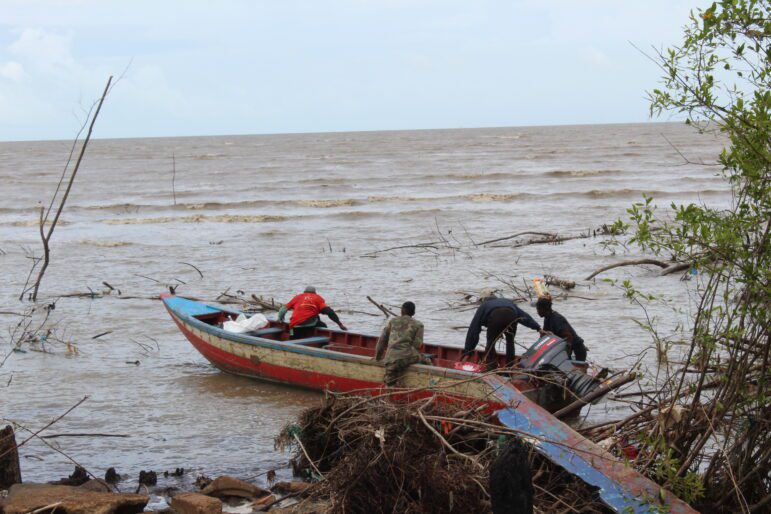
He points to neighboring Guyana. “Guyana managed to stabilise a major mudbank. They invest in nature-based solutions to protect their dike in Georgetown and contribute to carbon sequestration.” Hard infrastructure, he argues, comes at a cost. “A dike costs money, and economically it brings nothing. On the contrary, you must maintain it.”
Naipal believes Suriname needs a long-term vision for coastal management, one developed jointly by scientists, the government, and affected communities. And he issues a warning.
“We all live on the same planet and are not protected from natural disasters,” he says. “Seismologists from Tokyo and Japan are already warning that a tsunami could occur again. There is tectonic tension in the Caribbean and South America. Oil and gas are being pumped out. The chance for a natural disaster may be small, but if it happens, a few stones will not protect you.”