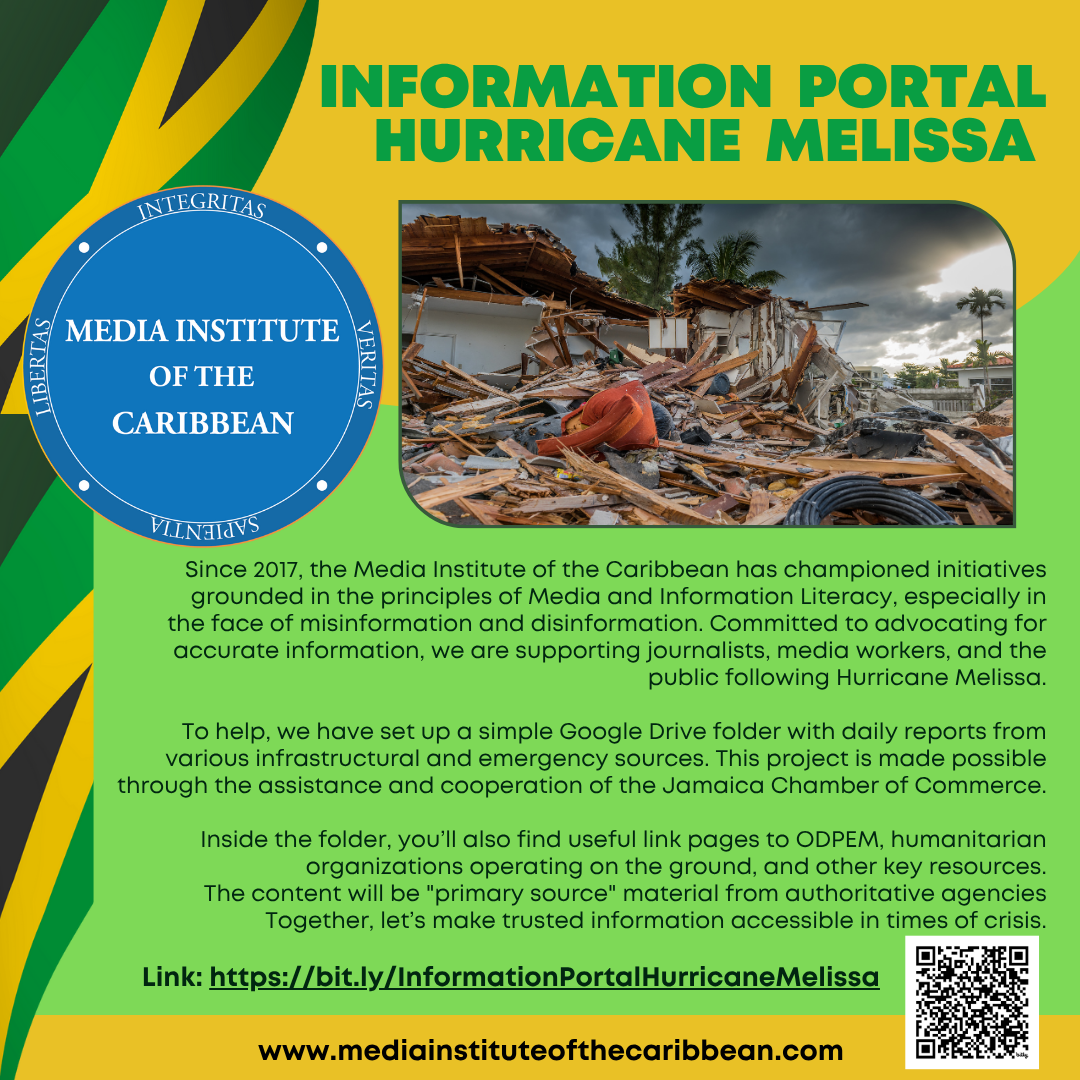
Information Portal Hurricane Melissa

Since 2017, the Media Institute of the Caribbean has championed initiatives grounded in the principles of Media and Information Literacy, especially in the face of misinformation and disinformation. Committed to advocating for accurate information, we are supporting journalists, media workers, and the public following Hurricane Melissa. To help, we have set up a simple Google Drive folder with daily reports from various infrastructural and emergency sources. This project is made possible through the assistance and cooperation of the Jamaica Chamber of Commerce. Inside the folder, you’ll also find useful link pages to ODPEM, humanitarian organizations operating on the ground, and other key resources.


Ripple Effect: A Comparative Study of Male Suicide in Trinidad and Tobago, Barbados, and Guyana – Part I

When he was asked what was being done to address male suicide in Trinidad and Tobago, the Minister of Health, Terrence Deyalsingh, said that recently the health ministry had signed a Memorandum of Understanding with the University of the West Indies (UWI) and UNICEF to establish a mental health chatline dedicated only to adolescents and youth. For those in their 30s, and 60 years and over, the national suicidal hotline among other resources would be there to assist. But for 24-year-old, Charran Prem Tom, who’d sought out mental health assistance, it had proven not enough. One of his close friends, Michael (who did not provide his last name), said Charran was depressed for a long time, yet had a smile and laughter capable of lighting up entire rooms. Charran worked as an AC technician and enjoyed going to the gym. Nine years ago in secondary school, Michael met Charran in Form 4 where they became good friends not long after.


In the Caribbean, Women and Girls Face Daily Threats of Sexual Violence; Getting Justice is Another Ordeal

For many Caribbean women, few places are safe from the threat of rape or sexual violence. Women report experiencing sexual violence in their workplaces and being violated by people in their towns and villages. Many times, the places that should be the safest for women are the most dangerous: their own homes. Homes are where many children–mainly young girls–are targeted for grooming, molestation and rape by a family member, neighbors or other people they know. Sexual violence of women in the region is so prevalent that Caribbean nations accounted for five of the world’s top 20 rape rates in 2019, according to the World Population Review, which studies demographics around the globe.


Did Dominica Build Back Better?

The night of September 18, 2017, forever altered the development trajectory of the Commonwealth of Dominica. Hurricane Maria’s 160 mph winds decimated the island, stripping vegetation, flattening homes, and crippling infrastructure. The devastation was catastrophic: 31 lives lost, thousands homeless, and damages amounting to USD $1.3 billion dollars – over twice the nation’s GDP. Dominica’s government, under Prime Minister Roosevelt Skerrit, vowed to rebuild as the world’s first climate-resilient nation, creating the Climate Resilience Execution Agency for Dominica (CREAD) to lead this ambitious mission. This documentary looks at the first few days of having been on the ground after Maria hit and now – seven years later – to find stories of resilience amidst ongoing challenges.